Your UK Payslip Explained: A Simple Guide for Nigerians Working in the UK
Understand your UK payslip with this simple guide for Nigerians. Learn about tax codes, PAYE, National Insurance, pensions, deductions and take-home pay.
Auntie Tobi
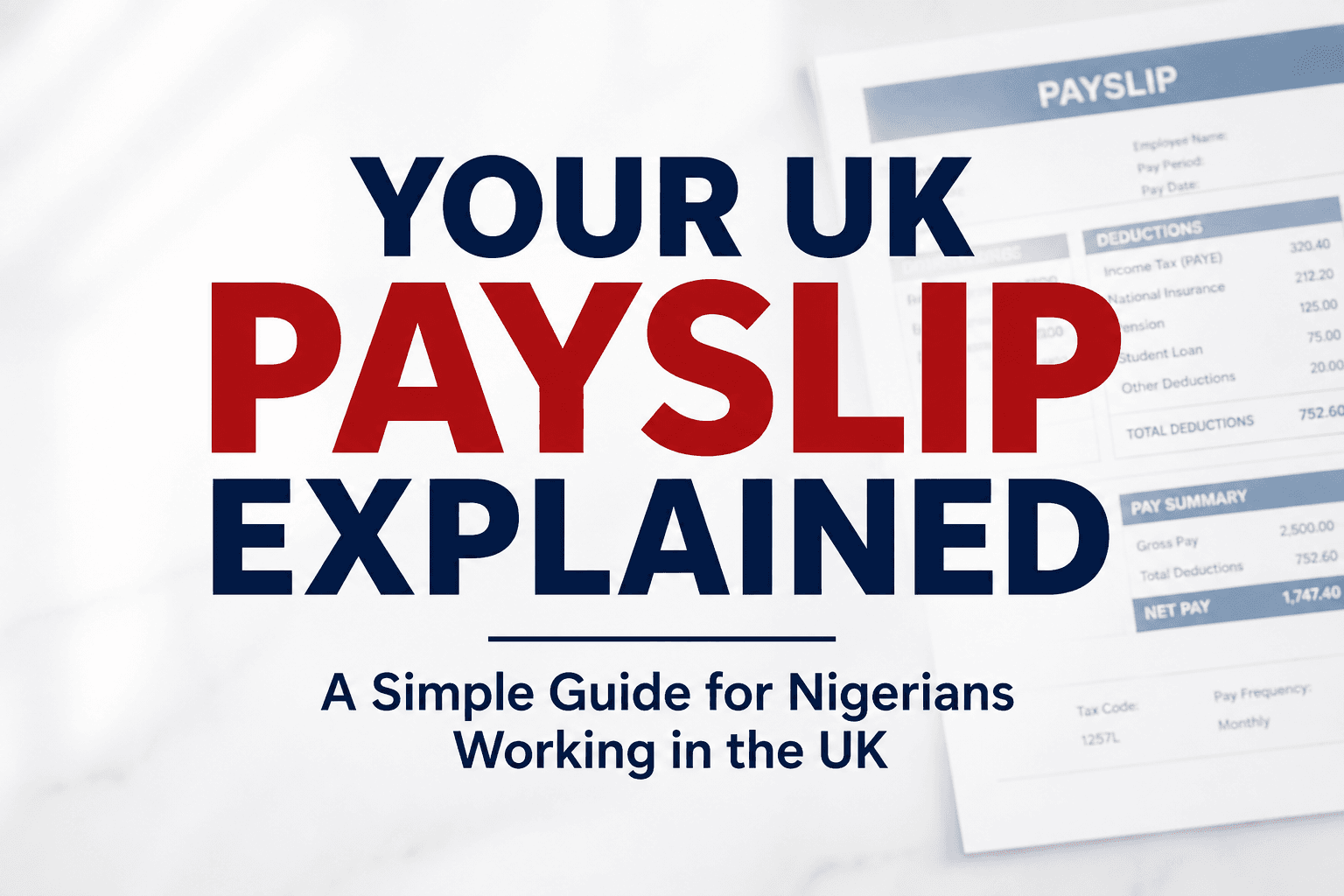
You worked all month, your salary finally lands… and then you look at your payslip and wonder:
“Wait — where did the rest of my money go?” 😭
If you're working in the UK, your salary before deductions and the amount that actually reaches your bank account can look very different.
That's because your employer may deduct things such as Income Tax, National Insurance, workplace pension contributions and student loan repayments before paying you.
If you've recently started working in the UK, understanding your payslip is important. It can help you spot an incorrect tax code, understand your deductions and make sure your pay looks right.
Here’s your simple Auntie Tobi guide.
First: You Have a Right to a Payslip
If you're an employee or worker, your employer generally has to give you a payslip on or before payday.
It can be printed or provided electronically.
Your payslip must show information including:
Your earnings before deductions
Your earnings after deductions
Deductions that can change from payday to payday, such as tax and National Insurance
The number of hours worked if your pay varies according to the hours you work
Your payslip is worth keeping because it can also provide evidence of your earnings, tax paid and pension contributions.
1. Gross Pay
Gross pay is what you've earned before deductions are taken out.
For example, imagine your gross monthly pay is:
£2,500
That does not necessarily mean £2,500 will arrive in your bank account.
Your employer may still need to deduct Income Tax, National Insurance and other applicable deductions.
If you work shifts, your gross pay might include several components, such as:
Basic pay
Overtime
Night enhancements
Weekend enhancements
Bonuses
Commission
This is particularly useful to check if you're a healthcare worker, support worker or anyone whose pay changes depending on shifts.
Make sure the hours, enhancements and rates shown match what you actually worked.
2. Income Tax / PAYE
You may see PAYE or Income Tax on your payslip.
PAYE means Pay As You Earn.
Instead of waiting until the end of the year to pay all your employment Income Tax yourself, your employer normally calculates the appropriate deduction through payroll and sends it to HMRC.
For the 2026/27 tax year, which runs from 6 April 2026 to 5 April 2027, the standard Personal Allowance is £12,570.
For someone receiving the full standard Personal Allowance in England, Wales or Northern Ireland, the main Income Tax bands are:
Up to £12,570 — 0%
£12,571 to £50,270 — 20%
£50,271 to £125,140 — 40%
Above £125,140 — 45%
There are important exceptions. For example, the Personal Allowance starts reducing when adjusted net income exceeds £100,000.
Scotland also has different Income Tax bands and rates for earnings, so don't automatically use the figures above if you're a Scottish taxpayer.
And here's an important misunderstanding to avoid:
Moving into the 40% tax band does NOT mean your entire salary suddenly gets taxed at 40%.
Income Tax operates in bands. The higher rate applies to the portion of taxable income that falls within that band.
3. Your Tax Code
This small combination of numbers and letters on your payslip is something you should pay attention to.
You might see something such as:
1257L
For many people entitled to the standard Personal Allowance, 1257L is a common tax code.
But don't assume that everyone should have 1257L.
Your tax code depends on your individual circumstances, and HMRC tells your employer which code to use.
You also receive a tax code for each employment or pension you have.
Your code can therefore be different if, for example, you:
Have more than one job
Receive taxable benefits from your employer
Have untaxed income
Owe tax from an earlier period
Receive certain tax allowances or reliefs
If your tax code changes, the amount of tax deducted from your salary may also change.
🚨 Starting a new job?
If you have a P45 from your previous employer, give it to your new employer.
If you don't have one, your employer may ask you to complete HMRC's Starter Checklist.
Incorrect or incomplete information when starting a job can affect how your PAYE tax is calculated.
4. National Insurance
Income Tax and National Insurance are not the same thing.
If you're employed, you normally pay Class 1 National Insurance when your earnings are high enough.
For most employees in the standard Category A during the 2026/27 tax year, employee National Insurance is:
0% up to the relevant Primary Threshold
8% on earnings between £1,048.01 and £4,189 per month
2% on earnings above £4,189 per month
These percentages apply to the relevant portions of your earnings — not necessarily your entire salary.
Different National Insurance category letters can have different rates, so your individual calculation may differ.
Your employer may also pay Employer National Insurance.
That's separate from the employee National Insurance deducted from your wages, so don't assume the employer's NI contribution should also be taken from your net salary.
5. Workplace Pension
Another deduction you may see is something like:
Pension
or the name of your pension provider.
UK employers must provide a workplace pension scheme, and eligible workers are normally automatically enrolled.
Generally, automatic enrolment applies if you:
Are classed as a worker
Are aged between 22 and State Pension age
Earn at least £10,000 a year
Usually work in the UK
For many automatic-enrolment schemes, the statutory minimum total contribution is 8% of qualifying earnings, with at least 3% coming from the employer.
However, pension arrangements vary.
The amount shown on your payslip and how tax relief is applied can depend on whether your scheme uses arrangements such as net pay or relief at source.
So don't compare your pension deduction with a friend's payslip and immediately assume yours is wrong.
Check the rules of your own workplace pension.
6. Student Loan or Postgraduate Loan
Some employees may also see:
Student Loan
or
Postgraduate Loan
on their payslip.
Repayments through payroll depend on factors including your earnings and which repayment plan applies to you.
Not everyone who studied at university will have this deduction.
If it appears unexpectedly, check with your employer and the relevant student loan guidance rather than ignoring it.
7. Other Deductions
Depending on your circumstances and workplace, you could also see deductions for things such as:
Workplace benefits
Payroll Giving
Child maintenance
Repayment of an employer loan or salary advance
Repayment of an earlier wage overpayment
Other deductions you've agreed to or that your employment contract permits
Employers cannot simply deduct money from your wages whenever they want.
Generally, a deduction must be required or allowed by law, authorised by your contract, agreed to by you in writing, or fall within another permitted category.
There are also rules about deductions reducing pay below the National Minimum Wage, although there are exceptions.
If you see a deduction you don't recognise, ask your payroll or HR department what it is.
8. Net Pay
Finally, we get to the number everybody is waiting for. 😂
Net pay is what remains after the relevant deductions have been taken.
In simple terms:
Gross Pay − Deductions = Net Pay
Your net pay is generally the amount that reaches your bank account.
So if someone says:
“I earn £40,000 a year.”
That doesn't mean they receive £3,333 in their bank every month.
£40,000 divided by 12 gives the approximate monthly gross salary, not the take-home amount after deductions.
9. What Does “Year to Date” Mean?
You may see YTD or Year to Date figures on your payslip.
These figures show totals accumulated during the tax year rather than just the current pay period.
Depending on your payslip, you might see year-to-date figures for:
Gross pay
Tax
National Insurance
Pension contributions
They're useful for keeping track of what you've earned and what has been deducted so far.
Remember that the UK tax year runs from 6 April to 5 April, not January to December.
10. Two Jobs? Check Both Payslips Carefully
This is particularly important for Nigerians who work more than one job.
For example, you might have:
Job 1: Full-time employment
Job 2: Bank shifts, weekend work or another part-time job
You will have a tax code for each employment.
Your Personal Allowance is not automatically a fresh £12,570 tax-free allowance for every job you have.
HMRC allocates tax codes according to your circumstances.
If you have multiple jobs and think too much or too little tax is being deducted, check your tax codes through HMRC.
What Should You Check Every Payday?
Don't just look at the amount that entered your bank account.
Take two minutes and check:
✅ Your name and employee details are correct
✅ Your hours are correct
✅ Your hourly rate or salary is correct
✅ Overtime has been included
✅ Night/weekend enhancements are correct, where applicable
✅ Your gross pay looks right
✅ Your tax code looks appropriate
✅ Income Tax deducted looks reasonable
✅ National Insurance is shown correctly
✅ Pension contributions look right
✅ You recognise any other deductions
✅ Your net pay matches what reached your bank account
A payslip shouldn't just be something you download and forget about.
What If You Think Your Tax Is Wrong?
Start by checking your payslip and tax code.
You can use HMRC's online services or the HMRC app to see your current tax code and information about the Income Tax you've paid.
If your tax code appears wrong, check with HMRC.
For questions about calculations or other items on your payslip, your employer's payroll or HR department may also be able to explain what has happened.
And if your employer has made a deduction you believe is unlawful, GOV.UK recommends first trying to resolve the issue with your employer. Further help may be available through Acas, Citizens Advice, a trade union or, where appropriate, an Employment Tribunal.
Auntie Tobi Says 💚
Please learn to read your payslip.
Don't assume payroll can never make a mistake.
Don't assume every tax code is correct simply because HMRC issued one.
And don't compare your take-home pay directly with someone else's just because you both earn the same salary.
Tax codes, pension arrangements, student loans, benefits and other circumstances can all affect how much eventually reaches your bank account.
A five-minute payslip check every month could help you spot a problem much earlier.
Save this guide and send it to someone who recently started working in the UK.
Official Sources
This article was checked against current official UK government guidance for the 2026/27 tax year.
GOV.UK — Payslips: employee rights
HMRC/GOV.UK — Check if the tax on your payslip is correct
GOV.UK — Income Tax rates and Personal Allowances
GOV.UK — Tax codes
GOV.UK — National Insurance rates and categories
GOV.UK — Workplace pensions
GOV.UK — Deductions from your pay
Last fact-checked: 22 August 2026
This article provides general information and is not individual tax, financial or legal advice.



Comments(0)