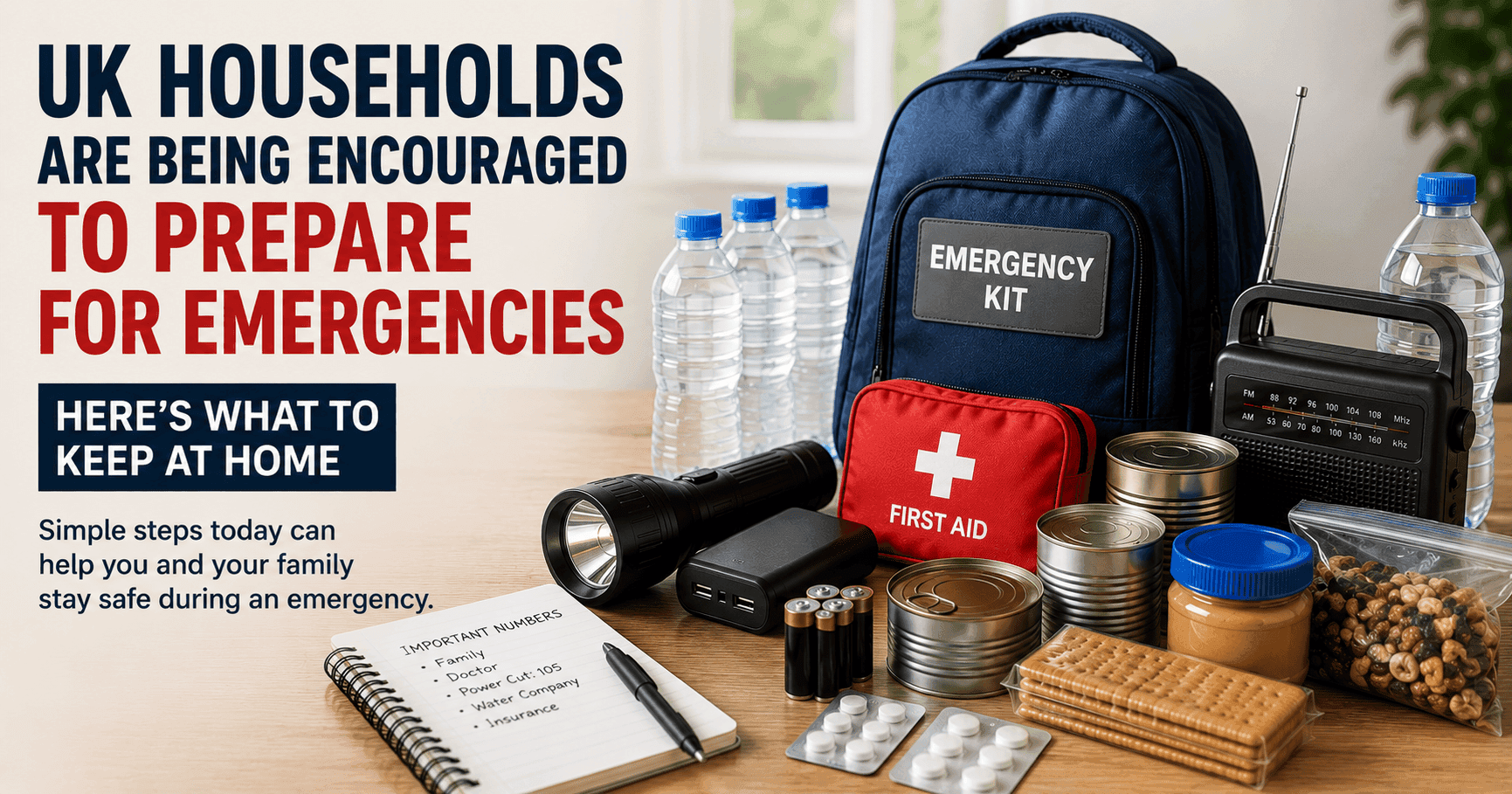
🚨 UK Households Are Being Encouraged to Prepare for Emergencies — Here's What to Keep at Home
UK households are encouraged to keep basic emergency supplies at home in case essential services are disrupted. Here's what the government recommends.
Auntie Tobi
You've probably seen headlines telling UK households to prepare to cope for three days without essential services.
Before anybody starts panic-buying bottled water and tinned food, there's some important context:
This is preparedness advice. It is NOT an announcement that the UK Government expects the country to lose electricity, water or other essential services in the next 72 hours.
The government's official Prepare campaign encourages households to think about what they might need during an emergency lasting a few days for example, a power cut or water outage, or a situation where people are advised to stay at home or evacuate for safety.
Here's what Nigerians and other households living in the UK should know.
🇬🇧 Why Is the Government Telling People to Prepare?
Emergencies can happen for many different reasons.
For example, severe weather or faults can cause power cuts, while burst water mains and other problems can interrupt water supplies.
The UK Government says most power cuts are short-lived and local. However, more widespread and longer outages are possible and could potentially last several days.
The idea behind preparing isn't to predict when an emergency will happen.
It's simply to make your household more resilient if something unexpected disrupts everyday services.
Think of it like having a smoke alarm or first-aid kit:
You don't have one because you're expecting an emergency tonight. You have one because emergencies can happen.
🏠 What Should You Keep at Home?
The government's Prepare campaign suggests putting together some basic emergency supplies.
These can include:
🔦 Battery-powered or wind-up torch
🔋 Portable power bank for your phone
📻 Battery-powered or wind-up radio
🔋 Spare batteries
🩹 First-aid supplies
💊 Enough essential medication for several days
🧴 Hand sanitiser and wet wipes
💧 Bottled drinking water
🥫 Non-perishable food that doesn't need cooking
👶🏾 Baby supplies, where needed
🐶 Food and other essentials for pets
The government specifically recommends a torch rather than candles because torches are safer. (Prepare)
💧 How Much Water Should You Keep?
This part needs some context.
The UK Government says there is no single standard amount because emergencies can last for different lengths of time and people's needs vary.
However, its Prepare guidance cites the World Health Organization recommendation of a minimum of approximately:
2.5 –3 litres of drinking water per person, per day for survival.
The guidance says around 10 litres per person per day would provide more comfort because it can also cover some basic cooking and hygiene needs.
Some households may need additional water for example, for baby formula, medical equipment or pets.
For perspective, the government's 2026 preparedness survey used 3 litres per person per day when assessing whether households had three days of bottled drinking water — equivalent to at least 9 litres per person for three days.
🥫 What Food Should You Keep?
Think about foods that:
Last for a reasonable amount of time + don't need refrigeration + can be eaten without cooking.
The government gives examples such as ready-to-eat tinned meat, fruit and vegetables.
And remember the tin opener. 😭
There's no point sitting in darkness looking at your tin of beans when nobody can open it.
You don't need to create an enormous emergency supermarket in your cupboard either.
The official advice specifically says households can build their emergency kit gradually when they're able, rather than buying everything at once.
💊 Don't Forget Medication
If someone in your household relies on essential medication, this should be part of your planning too.
The government's guidance recommends making sure you have enough necessary medication to keep you going for several days.
If you rely on medical equipment, consider keeping paper instructions and charged backup batteries where appropriate.
Never change how you obtain or take prescription medication simply to build an emergency stockpile without appropriate advice.
👶🏾 Families With Babies May Need Extra Supplies
Parents should think about what their baby would need if electricity or water were unavailable.
The government's emergency-kit guidance includes:
Nappies and baby formula.
For formula-fed babies, the Prepare campaign says ready-made or ready-to-feed formula can be useful because an emergency may leave you unable to boil water or sterilise bottles.
🐶 Remember Your Pets
Your emergency preparation should include the animals in your household too.
That could mean keeping enough:
Pet food + drinking water + essential medication or supplies
to manage a short disruption.
📻 Why Would You Need a Radio in 2026?
This one might sound old-fashioned until you think about what happens during a prolonged power cut.
No electricity can mean:
No Wi-Fi.
And depending on the situation, mobile networks can also be affected.
The government therefore recommends having a battery-powered or wind-up radio so you can receive information if normal communications are disrupted.
📱 Write Important Numbers Down Too
Most of us keep every phone number inside our phones.
But what happens when your battery dies?
The government recommends keeping important numbers written on paper.
For example, the number for reporting a power cut is:
105 — England, Scotland and Wales
For Northern Ireland, the government's Prepare guidance gives:
03457 643643.
You could also write down family contacts, insurance details and other numbers you'd need during an emergency.
🤝 Check on People Who May Need Extra Support
Emergency preparedness isn't only about buying supplies.
The government's advice also encourages people to exchange contact details with neighbours and consider whether anyone nearby might need additional help during an emergency.
That could include people with additional medical needs, older or vulnerable neighbours, people who are digitally excluded or those who may have difficulty accessing information.
Some people may also be eligible to join their gas, electricity or water provider's Priority Services Register, which can help suppliers know that additional support may be required during an interruption.
⚠️ Does This Mean Something Is About to Happen?
No.
This distinction is important.
The government's Prepare website is an ongoing public preparedness programme covering emergencies including flooding, power cuts, water outages and other disruptions.
The advice to keep emergency supplies at home should not be interpreted as evidence that the government knows a nationwide emergency or three-day shutdown is imminent.
There is no need to panic-buy.
The official guidance actually encourages households to add supplies gradually when they can.
✅ Your Simple Household Emergency Checklist
If you want to prepare gradually, start with:
💧 Bottled drinking water
🥫 Non-perishable, ready-to-eat food + tin opener
💊 Essential medication
🔦 Torch
🔋 Spare batteries
📱 Charged power bank
📻 Battery/wind-up radio
🩹 First-aid supplies
🧴 Hand sanitiser/wet wipes
👶🏾 Baby essentials, if needed
🐶 Pet supplies, if needed
📄 Important phone numbers written on paper
Keep your emergency supplies somewhere easy to find — particularly somewhere you could locate them if the lights weren't working.
💚 Auntie Tobi Says
Prepare, but don't panic.
Nobody needs to rush to the supermarket and clear the shelves because of a scary social-media headline.
The message is much simpler:
If your electricity disappeared tonight, your water supply stopped temporarily or severe weather meant you couldn't easily leave home, could your household comfortably manage the first few days?
If the answer is no, start building a small emergency kit gradually.
Hopefully you'll never need it.
But if you do, you'll be glad it's there.
SAVE this checklist and SHARE it with another UK household.
🔗 Official sources
UK Government Prepare — Get prepared for emergencies
UK Government Prepare — Power cuts
UK Government Prepare — Water supply interruptions
GOV.UK — UK Public Survey of Risk Perception, Resilience and Preparedness 2026
This article provides general preparedness information. During an actual emergency, follow instructions from the emergency services, government and relevant local authorities.


Comments(0)