UK Emergency Numbers Explained: When to Call 999, 111, 101 and 105
Confused about UK emergency numbers? Learn when to call 999, NHS 111, police 101 and power-cut number 105 with this simple UK guide.
Auntie Tobi
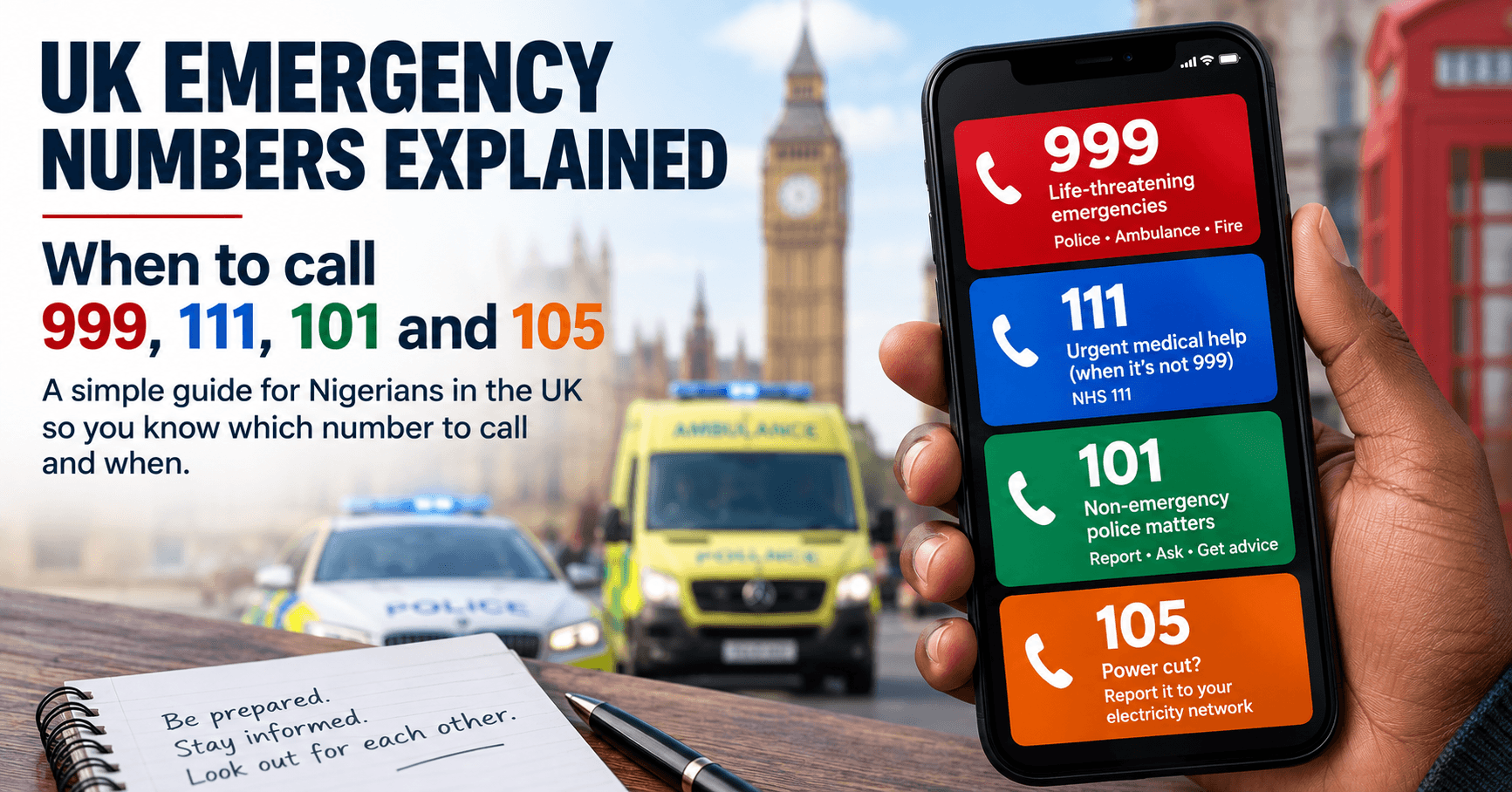
Imagine something happens and you need help quickly.
Someone suddenly collapses. Your child becomes unwell at night. You need to report a crime that isn't an emergency. Or everywhere in your house suddenly goes dark.
Which number do you call?
If you've moved to the UK from Nigeria, there are a few numbers worth knowing because 999 isn't the right number for every situation.
Here are four numbers that could save you plenty of confusion:
999 — Emergency services
111 — Urgent medical help
101 — Non-emergency police
105 — Electricity power cuts in Great Britain
Let's break them down simply.
🚨 999 — When There Is a Serious Emergency
Call 999 when someone is in immediate danger, a serious crime is happening, or there is a life-threatening medical emergency.
For medical emergencies, the NHS gives examples including heart attacks, strokes and serious road traffic accidents.
You can also call 999 when a crime is in progress or someone is in immediate danger.
When you call, the operator will ask which emergency service you need.
That could include:
🚑 Ambulance
🚓 Police
🚒 Fire and Rescue
🌊 Coastguard
You may then be asked where the emergency is, what has happened and how you can be contacted.
Examples of when to call 999
Someone is unconscious and not responding.
Someone appears to be having a heart attack or stroke.
Someone is struggling seriously to breathe.
There is severe bleeding.
There is a serious fire.
Someone is in immediate danger.
A serious crime is happening right now.
If you believe someone's life is in danger, don't waste time searching online for another number — call 999.
🇬🇧 What About 112?
Here's another useful one to know.
112 also works in the UK.
It is the pan-European emergency number and connects you to the same UK emergency response system as 999. (GOV.UK)
So:
999 = UK emergency number
112 = also works for emergencies in the UK
You don't need to call both.
🏥 111 — When You Need Medical Help, But It Isn't a Life-Threatening Emergency
This is one every household should know.
Use NHS 111 when you think you need medical help right now, but the situation isn't a life-threatening emergency.
NHS 111 can assess what you've told them and direct you to the most appropriate service. Depending on the situation, that could include an urgent treatment centre, out-of-hours GP, pharmacist, dental or mental-health support, or advice on safely managing the problem at home.
And if their assessment shows that you actually need emergency help, 111 can arrange an ambulance.
Think of it this way:
Emergency threatening life? → 999
Need medical help now but it doesn't appear life-threatening? → 111
And if you're simply unsure whether the situation requires 999, the NHS says 111 can help you decide what to do.
📱 Can You Use NHS 111 Online?
Yes, but there's an important geographical distinction.
111 online is an NHS England service. It is available for people aged 5 and over.
For a child under 5, NHS guidance says to call 111 instead.
Scotland, Wales and Northern Ireland have their own NHS/health-service arrangements, although 111 telephone services are also used in Scotland and Wales.
👮🏾 101 — When You Need the Police, But It Isn't an Emergency
This is where people sometimes get confused.
101 is the police non-emergency number.
You can use it to report a crime that isn't currently an emergency, provide information to the police or make a police enquiry.
For example, imagine you discover that your property was damaged overnight, but nobody is currently in danger and the offender is long gone.
That may be appropriate for 101 or your police force's online reporting service, rather than 999.
But if you can see someone breaking into a property right now, or somebody is in immediate danger:
Call 999.
GOV.UK confirms that calls to both 999 and 101 are free.
⚡ 105 — When Your Electricity Goes Off
Now this one is much less well known.
If you have an electricity power cut in England, Scotland or Wales, remember:
105
It connects you with the electricity network operator responsible for your area.
Ofgem advises households experiencing a power cut to report it to their electricity network operator, and the Energy Networks Association identifies 105 as the number used across Great Britain.
You can also use 105 to report dangerous damage involving electricity-network equipment, such as damaged power lines or substations.
But there's an important safety rule:
If there is an immediate serious danger, call the emergency services too.
⚠️ 105 Is NOT Your Energy Supplier's Customer-Service Number
Another useful distinction.
Your electricity supplier is the company you buy your electricity from.
Your electricity network operator manages the network carrying electricity to homes and businesses in your area.
If there's a network power cut, 105 connects you to the network operator.
If your electricity has stopped because of something such as a faulty meter, Ofgem says you should contact your energy supplier instead.
🇬🇧 Does 105 Work Everywhere in the UK?
Not quite.
This is why Auntie Tobi doesn't want to simply say “105 is the UK power-cut number.”
105 applies in Great Britain — England, Scotland and Wales.
Energy Networks Association guidance gives Northern Ireland's electricity-network emergency number as:
03457 643 643. (
So if you live in Northern Ireland, don't rely on 105.
🔥 One More Number Worth Saving: Gas Emergency
Since we're talking about household emergencies, here's another important one.
If you smell gas or suspect a gas leak in Great Britain, Ofgem says to call the National Gas Emergency Service immediately:
0800 111 999 (Ofgem)
Don't confuse this with 999.
If the situation also presents an immediate danger to life, contact the emergency services.
💚 The Easy Way to Remember Them
Save this:
🚨 999 — LIFE-THREATENING EMERGENCY
🏥 111 — URGENT MEDICAL HELP
👮🏾 101 — NON-EMERGENCY POLICE
⚡ 105 — ELECTRICITY POWER CUT (GREAT BRITAIN)
And one bonus:
🔥 0800 111 999 — GAS EMERGENCY (GREAT BRITAIN)
These are the kinds of numbers you don't want to start Googling for the first time when you're already stressed.
Save them in your phone and make sure other people in your household including older children who are able to understand what to do in an emergency, know where to find them.
💚 Auntie Tobi Says
Living in the UK isn't only about knowing where to shop, how Council Tax works or understanding your payslip.
Sometimes it's knowing who to call when something goes wrong.
Remember the simple version:
999 = emergency
111 = urgent health help
101 = police, but not an emergency
105 = electricity power cut in Great Britain
Save this guide somewhere you can find it.
Hopefully, you'll never need some of these numbers but if you do, you'll know exactly where to start.
Official sources
GOV.UK — 999 and 112: UK's national emergency numbers
GOV.UK — Contact the police: 999 and 101
Information is general guidance. In an immediate life-threatening emergency, call 999.


Comments(0)