Stopped by the Police in the UK? Know These Basic Rights 👀🇬🇧
Stopped by the police in England or Wales? Learn your basic rights when questioned, searched or stopped while driving, and when you must provide information.
Auntie Tobi
Hopefully, you'll never be in a situation where you need this information.
But this is one of those guides worth reading before you need it.
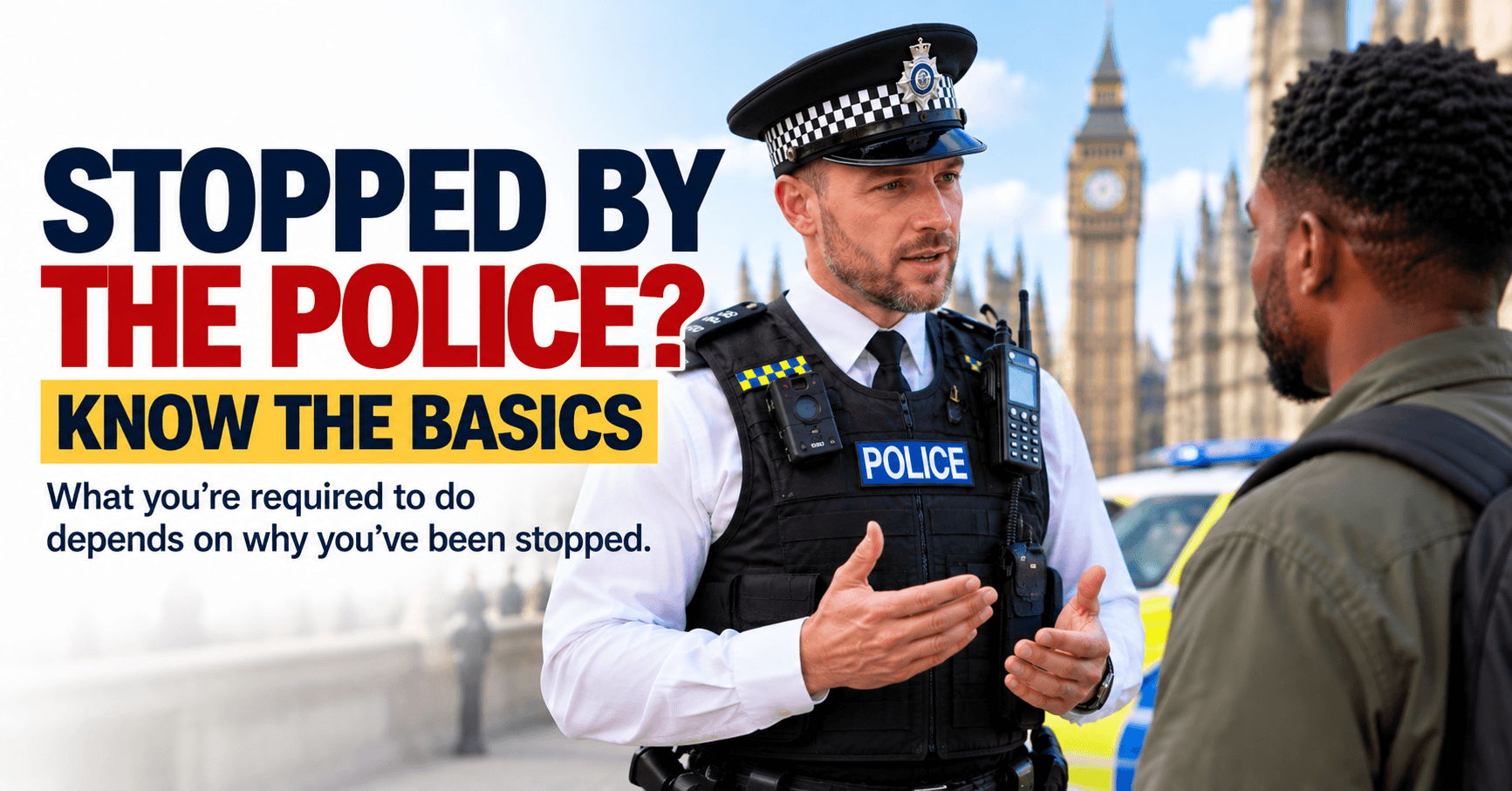
Being approached or stopped by a police officer does not automatically mean you've committed an offence. And importantly, what you're legally required to do depends on why the police have stopped you.
For this guide, we're focusing mainly on England and Wales, because police powers and procedures are different in Scotland and Northern Ireland.
👮🏾 1. Police Stop You and Simply Ask Questions
A police officer can approach you and ask questions.
They might ask:
“What is your name?”
“What are you doing here?”
“Where are you going?”
But if this is simply a police officer stopping to speak to you, GOV.UK says:
“You do not have to stop or answer any questions.”
Importantly, refusing to answer questions on its own cannot be used as the reason to search or arrest you if there is no other reason for suspicion.
So don't automatically assume that because a police officer asks for your name, you must provide it in every encounter.
A useful question can simply be:
“Why have I been stopped?”
Or:
“Am I required to give my details?”
The answer depends on what legal power, if any, the officer is exercising.
🔍 2. What If It's a Stop and Search?
This is different from simply being asked questions.
Police have legal powers to stop and search someone in certain circumstances.
For example, an officer may stop and search you where they have reasonable grounds to suspect you're carrying things such as illegal drugs, a weapon, stolen property or something that could be used to commit a crime. There are also specific circumstances where searches can take place without individual reasonable grounds following appropriate authorisation.
If you're lawfully detained for a search, you cannot simply refuse the search and walk away.
But you have rights too.
Before carrying out the search, the officer must provide information including their identity/police station, what they expect to find, why they want to search you and the legal power they're using. They must also explain your entitlement to a record of the search.
Important: being searched does NOT mean you're under arrest.
Those are two different things.
🪪 Do You Have to Give Your Name During a Stop and Search?
Here's another area where misinformation can spread easily.
Under the ordinary stop-and-search process, you are not automatically required to give your name, address and date of birth simply so the police can complete the search record.
The official PACE guidance specifically says there is no requirement to record those details for that purpose and the person searched is under no obligation to provide them.
However, that doesn't mean:
“You never have to give the police your details.”
There are other circumstances and legal powers where you can be required to provide information.
That's why understanding why you've been stopped matters.
🚗 3. What If Police Stop You While Driving?
Very different situation.
Police can stop a vehicle, and if they signal you to stop, you must pull over when it is safe.
Failing to stop is an offence.
Police can also ask to see your:
Driving licence
Insurance certificate
MOT certificate
If you don't have requested documents with you, GOV.UK says you generally have seven days to take them to a police station. Failing to produce requested documents within that period is an offence.
So please don't apply the social-media advice:
“You never have to tell police anything.”
to a traffic stop.
The circumstances matter.
🚨 4. What If You're Being Arrested?
Again, this is different.
If police arrest you, GOV.UK says they must:
identify themselves as police,
tell you that you're being arrested,
tell you what offence they suspect you of committing,
explain why the arrest is necessary,
and make clear that you're not free to leave.
If you're unsure whether an interaction is simply a conversation or whether you're being detained, you can calmly ask:
“Am I free to leave?”
📹 What About Body-Worn Cameras?
Don't be surprised if the encounter is being recorded.
For stop and search, GOV.UK says that before the search the officer must tell you if they're recording you using a body-worn camera.
That doesn't automatically mean you've done something wrong.
📝 Can You Get a Record of a Stop and Search?
Yes.
Before a search, police should explain that you can have a record of it and, if one cannot be provided immediately, how you can obtain a copy.
It can be useful to keep that information, particularly if you later want to raise a concern about how the encounter was handled.
⚠️ What If You Think the Police Treated You Unfairly?
Try to distinguish between knowing your rights and escalating the situation unnecessarily.
You can remain calm, ask what power is being used and remember relevant details about what happened.
If you're unhappy with how police treated you, GOV.UK says you can complain to the police force concerned. Certain complaints must be referred to the Independent Office for Police Conduct (IOPC).
💚 Auntie Tobi Says
The biggest takeaway isn't:
“Never answer the police.”
And it isn't:
“You must answer everything the police ask.”
Both are too simplistic.
Instead, remember:
Ask why you've been stopped and understand what kind of police power is being used.
A casual conversation, a stop and search, being stopped while driving and being arrested are not the same situation.
So if you're stopped:
Stay calm. Ask why you've been stopped. Ask whether you're required to provide your details. And don't rely on a 20-second TikTok video for legal advice. 😂
Official sources
GOV.UK — Police powers to stop and question
GOV.UK — Police powers to stop and search


Comments(0)