How the UK School System Works: A Guide for Nigerian Parents
New to the UK with children? Understand the school system in England, including Reception, primary and secondary school, year groups, admissions, GCSEs, sixth form, attendance, free school meals and SEND support.
Auntie Tobi
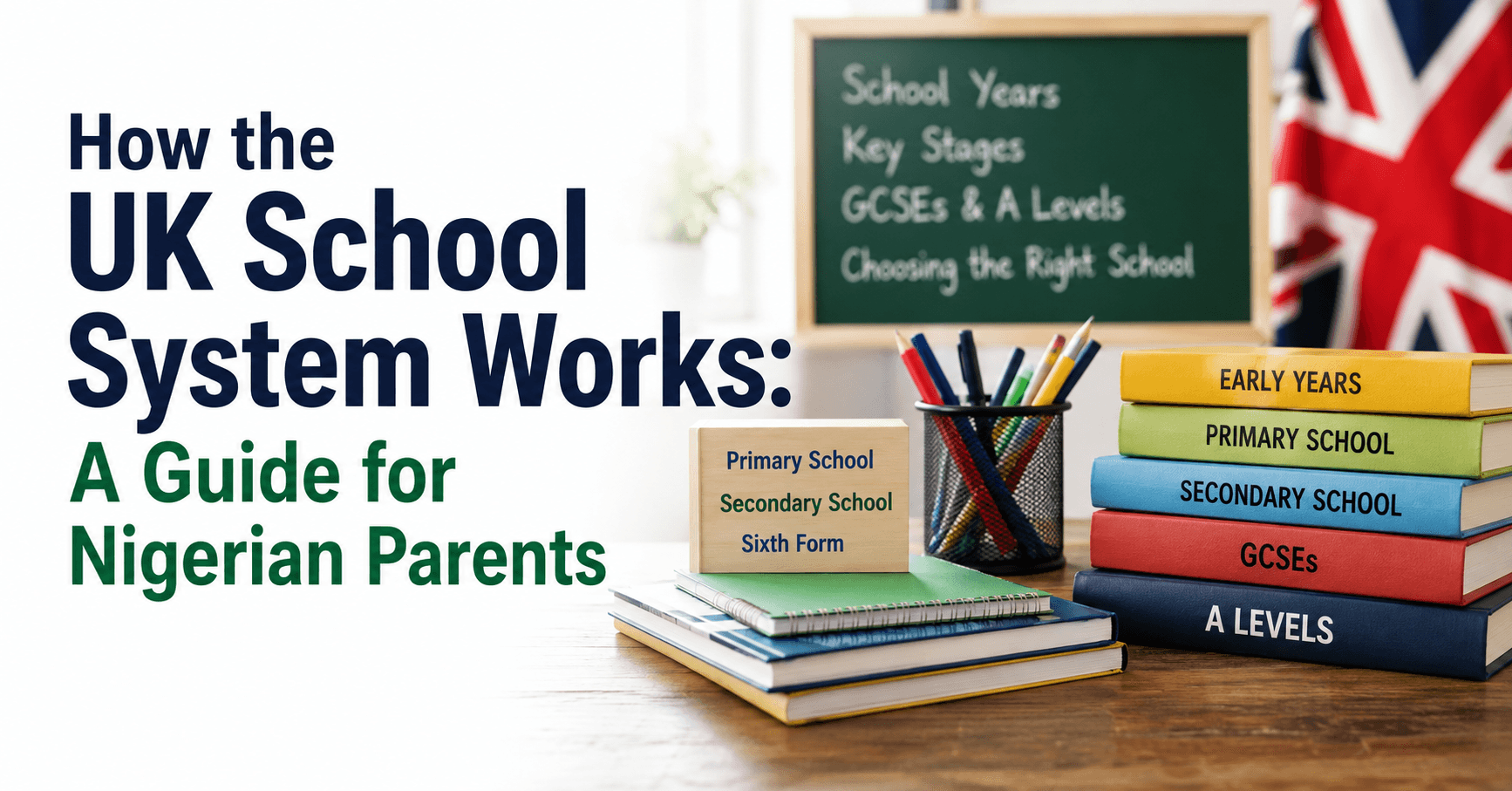
Moving to the UK with children comes with a long list of things to figure out and school is usually near the top.
If you're coming from Nigeria, terms such as Reception, Year 6, catchment area, Ofsted, GCSE, sixth form and SEND can initially sound confusing.
The first thing to understand is that there isn't one identical “UK school system”. Education is devolved, meaning England, Scotland, Wales and Northern Ireland have different systems and rules.
This Auntie Tobi guide focuses mainly on schools in England.
🎒 1. What Age Do Children Start School in England?
Most children start Reception in September after their fourth birthday.
Reception is the first year of primary school for most children and forms the final year of the Early Years Foundation Stage.
However, compulsory school age is slightly different.
Children must receive a suitable full-time education from the school term after their fifth birthday.
So don't confuse:
Starting Reception at age 4 with reaching compulsory school age.
📚 2. Understanding the School Years
One of the easiest ways for Nigerian parents to understand the English system is by looking at the year groups.
Age* | School Year | Stage |
|---|---|---|
4–5 | Reception | Early Years |
5–6 | Year 1 | Key Stage 1 |
6–7 | Year 2 | Key Stage 1 |
7–8 | Year 3 | Key Stage 2 |
8–9 | Year 4 | Key Stage 2 |
9–10 | Year 5 | Key Stage 2 |
10–11 | Year 6 | Key Stage 2 |
11–12 | Year 7 | Key Stage 3 |
12–13 | Year 8 | Key Stage 3 |
13–14 | Year 9 | Key Stage 3 |
14–15 | Year 10 | Key Stage 4 |
15–16 | Year 11 | Key Stage 4 |
16–17 | Year 12 | Sixth Form/College |
17–18 | Year 13 | Sixth Form/College |
*These are the usual ages; individual circumstances can differ.
Primary education generally runs from Reception to Year 6, with children moving to secondary school for Year 7.
🏫 3. Primary School: Reception to Year 6
Primary school normally covers children from approximately 4 to 11 years old.
It includes:
Reception: 4–5
Key Stage 1: Years 1–2
Key Stage 2: Years 3–6
Children study a broad curriculum including English, maths, science, computing, history, geography, art, music and PE.
Unlike what some Nigerian parents may be accustomed to, academic performance isn't necessarily communicated through a position such as:
“Your child came 3rd out of 30 pupils.”
Schools assess children's learning and progress in different ways, and parents will usually receive reports and opportunities to discuss progress with teachers.
🎓 4. Secondary School: Years 7–11
Most children move to secondary school at around age 11.
Secondary school includes:
Key Stage 3: Years 7–9
Key Stage 4: Years 10–11
During secondary school, students study a broader range of subjects before specialising more as they approach their GCSEs.
The national curriculum covers subjects including English, mathematics, science, computing, history, geography, languages, citizenship and others.
📝 5. What Are GCSEs?
GCSE stands for General Certificate of Secondary Education.
Students generally work towards GCSE qualifications during Years 10 and 11, although preparation and subject choices can begin earlier.
English, maths and science are central subjects, while students may also take subjects such as:
History
Geography
Computer Science
Business
Art
Music
Languages
Design and Technology
The exact subjects available depend partly on the school.
GCSE results can influence what a young person goes on to study at sixth form, college or through an apprenticeship.
🎓 6. What Happens After Year 11?
Finishing Year 11 does not necessarily mean finishing education.
Young people have several possible routes, including:
📖 Sixth Form
Usually Years 12 and 13.
Students commonly study A levels or other qualifications.
🏫 Further Education College
Students may study vocational or technical qualifications as well as academic courses.
🛠️ Apprenticeship
A young person can combine paid employment with training and study.
The important point for parents is that university is not the only successful route available to a child in England.
A levels → university is one pathway.
But college, technical education and apprenticeships can also lead to strong careers.
📍 7. How Do You Get Your Child Into a School?
This is where many parents new to England become confused.
For normal primary and secondary admissions, you generally apply through the local council where you live, even when the school you want is located in another council area.
You normally list several schools in order of preference.
And this is important:
Choosing only one school does NOT increase your chances of getting it.
GOV.UK specifically advises parents that listing only one preference does not improve the likelihood of receiving a place there.
📅 8. Don't Miss the School Application Deadlines
If your child is starting primary school, applications generally open in September and the national closing date is:
15 January
For secondary school, the national closing date is:
31 October
Missing the deadline can reduce the likelihood of receiving one of your preferred schools.
Primary school offers are normally made on 16 April, while secondary offers are normally made on 1 March, or the next working day where applicable.
💚 Auntie Tobi Tip: If your child is currently in Year 6, don't wait until the following summer before thinking about secondary school. The application deadline comes much earlier.
🏡 9. What Is a Catchment Area?
You may hear parents say:
“We moved there because of the school catchment.”
A catchment area is broadly the geographical area associated with a school for admissions purposes.
But living near a school does not automatically guarantee you a place.
Every school has admission criteria.
Depending on the school, priority may take account of things such as:
how close you live to the school
whether a sibling already attends
faith criteria
whether the school is selective
attendance at a feeder school
certain pupil-premium criteria
Different schools can have different admission arrangements.
So before renting or buying a house because of a particular school, read that school's actual admission policy.
🔎 10. How Do You Know Whether a School Is Good?
Don't rely solely on someone saying:
“That school is very good.”
Research it yourself.
Parents can look at:
Ofsted reports — inspection information about schools.
School performance data — including published attainment and progress measures.
School website — curriculum, behaviour policy, SEND information and admissions arrangements.
Open days — particularly important when choosing secondary schools.
GOV.UK specifically recommends looking at Ofsted reports, performance information, visiting schools and speaking to other parents.
🚚 11. What If You've Just Arrived From Nigeria?
You don't have to wait until the next September admissions round if your child needs a school now.
If you've moved during the academic year, you can make what is called an:
In-year application
Contact your local council. They can explain which schools have places and how applications work in your area.
If you're still abroad and preparing to move to England, GOV.UK advises contacting the council in the area where you intend to live. The council may ask for evidence that you'll be living there before the relevant school term begins.
❌ 12. What If You Don't Get the School You Want?
Don't panic.
You may be able to:
accept the school you've been offered
join the waiting list for your preferred school
appeal the admission decision where appropriate
Being offered another school does not prevent you from joining a waiting list for a school you prefer.
Admission authorities must keep their waiting lists open for at least the first term of the school year. (GOV.UK)
🏫 13. State School, Academy, Grammar School or Private School?
You'll come across several types of schools.
State-funded schools
These are publicly funded and generally do not charge parents tuition fees.
Academies
Academies are state-funded but operate independently of the local authority and have more freedom over certain aspects of how they operate.
Faith schools
These may have a religious character and faith can sometimes form part of their admissions criteria.
Grammar schools
These are selective state schools. Admission can involve an entrance examination, commonly referred to as the 11-plus.
Grammar schools are not available in every area.
Independent or private schools
These charge fees and parents generally apply directly to the school rather than through the normal local-authority admissions process.
🍎 14. Does Your Child Qualify for Free School Meals?
This is particularly important for parents going into the 2026–27 school year because the rules are changing.
All pupils in Reception, Year 1 and Year 2 at government-funded schools in England continue to qualify for universal infant free school meals.
And from the beginning of the 2026–27 academic year, England is expanding free school meal eligibility so that children in households receiving Universal Credit can qualify regardless of household earnings, subject to the scheme rules and eligibility verification. (
What if your immigration status says “No Recourse to Public Funds”?
Don't automatically assume your child cannot receive free school meals.
The government has permanently extended eligibility to certain children in households with No Recourse to Public Funds (NRPF), subject to income thresholds and other criteria.
Ask your child's school or local authority to check your circumstances.
🧩 15. What Does SEND Mean?
SEND stands for:
Special Educational Needs and Disabilities
A child may need additional support if they have difficulties affecting their ability to learn or participate at school.
Support can include help with areas such as communication, learning, physical needs, sensory needs, behaviour or social and emotional development.
Some children with more significant needs may have an Education, Health and Care (EHC) plan.
If an EHC plan names a particular school, that school must admit the child.
If you're worried about your child's development or progress, speak to the school rather than waiting for the problem to become severe.
📆 16. Can You Take Your Child to Nigeria During Term Time?
This catches many parents out.
Generally, you cannot simply take your child out of school for a family holiday during term time.
Schools can authorise absence in exceptional circumstances, but an ordinary holiday is generally not considered exceptional.
Unauthorised term-time absence can lead to a fine or other legal action.
So cheaper flights to Lagos during school term are not automatically a valid reason to take your child out of school.
Always speak to the school before making plans.
🗓️ 17. When Are the School Holidays?
The school year is generally divided into:
Autumn term
September → December
Spring term
January → around Easter
Summer term
April → July
Within these are shorter half-term holidays.
But exact dates can vary between councils and individual schools.
Don't book travel based solely on another parent's school calendar.
18. One Cultural Difference Nigerian Parents Should Understand
British schools may communicate differently from schools you're familiar with in Nigeria.
Teachers may talk about:
progress
expected standards
behaviour
wellbeing
additional support
safeguarding
attendance
If you're unsure what something means, ask.
Attend parents' evenings.
Read school emails.
Download whatever parent app your school uses.
Check homework platforms.
And don't wait until there's a serious problem before communicating with the teacher.
Your relationship with the school can make navigating the system much easier.
💚 Auntie Tobi Says
If you're new to the UK, don't put pressure on yourself to understand the entire education system immediately.
Start with five things:
1️⃣ Know your child's correct year group.
2️⃣ Learn your council's school-admission process.
3️⃣ Research several schools — not just the one everyone recommends.
4️⃣ Pay attention to application deadlines and attendance rules.
5️⃣ Ask what financial or additional support your child may qualify for.
And remember: the school closest to your house isn't automatically the school your child will get.
Research the admissions criteria before making major decisions about where to live.
📌 SAVE THIS QUICK GUIDE
Age 4–5 → Reception
Age 5–11 → Primary
Age 11–16 → Secondary
Years 10–11 → GCSE stage
Age 16+ → Sixth Form / College / Apprenticeship
Primary application deadline → 15 January
Secondary application deadline → 31 October
Official Sources
GOV.UK — Schools and education
GOV.UK — School attendance and absence
GOV.UK — Find and compare schools in England
Note: This guide focuses on England. Scotland, Wales and Northern Ireland have different education systems, terminology and admissions arrangements.



Comments(0)