💷 Energy Price Cap Rises 4% From October 2026: What UK Households Need to Know
The UK energy price cap rises 4% from October 2026. Find out what the new cap means for household energy bills and how the changes could affect you.
Auntie Tobi
If you pay your own gas and electricity bills in the UK, there's another change coming this autumn.
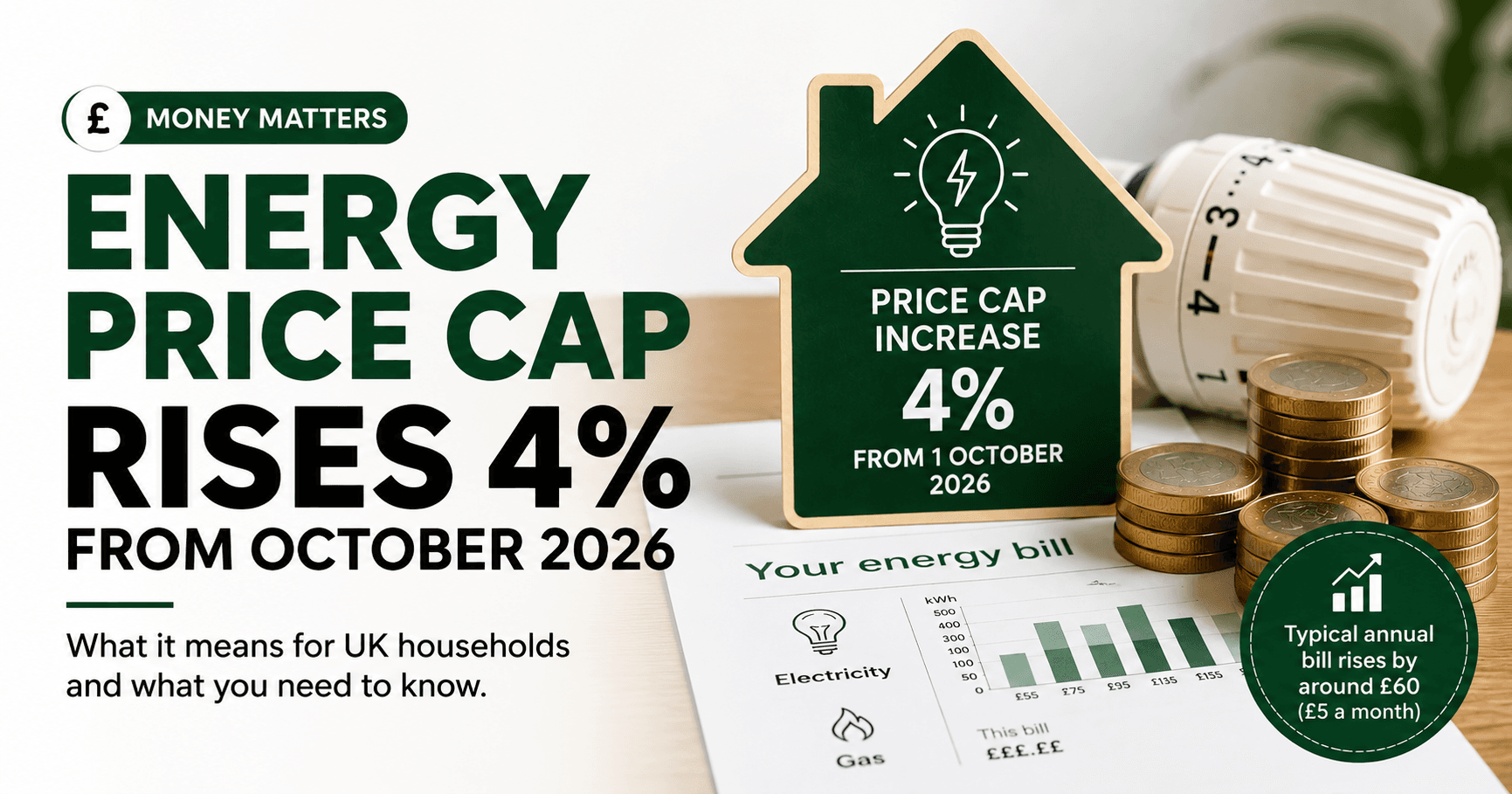
Energy regulator Ofgem has confirmed that the energy price cap will increase by 4% from 1 October 2026.
For a typical household using gas and electricity and paying by Direct Debit, Ofgem's headline annual figure will rise from £1,663 to £1,723.
That's an increase of around £60 a year — or £5 a month — if the October cap level were maintained for a full year.
But before you start calculating 4% on top of your current energy bill, there's something important to understand.
The £1,723 Figure Is NOT a Maximum Annual Bill
This is one of the biggest misunderstandings about the energy price cap.
The price cap does not mean:
“Nobody can pay more than £1,723 a year.”
You absolutely can pay more or less.
The cap limits the rates suppliers can charge customers on default tariffs for each unit of gas and electricity, together with standing charges.
Your actual bill still depends on factors including:
How much energy you use
Where you live
How you pay
Your meter type
Whether you use gas, electricity or both
So a larger household using considerably more energy could pay much more than £1,723.
A household using less energy could pay less.
When Does the New Price Cap Start?
The new cap applies from:
1 October 2026 to 31 December 2026.
Ofgem reviews and updates the energy price cap every three months.
That means the October figure isn't guaranteed to remain at the same level throughout 2027.
The next cap, covering January to March 2027, is due to be announced by Ofgem in November 2026.
How Much Are Energy Prices Increasing?
For a typical household using both gas and electricity and paying by Direct Debit:
Current headline figure: £1,663 a year
From 1 October: £1,723 a year
Difference: £60
Increase: 4%
Again, these are typical-use illustrations rather than fixed bills.
What Are the New Unit Rates?
From 1 October to 31 December 2026, Ofgem says the average Direct Debit rates across England, Scotland and Wales for customers on standard variable tariffs will be:
⚡ Electricity
26.32p per kWh
Average standing charge:
54.83p per day
🔥 Gas
7.97p per kWh
Average standing charge:
29.68p per day
Rates vary by region, payment method and meter type, so the figures on your own tariff may differ.
There's Also an Important VAT Change
Something unusual is happening at the same time.
The government is removing VAT from domestic electricity bills from 1 October 2026 until 31 March 2027.
Gas will continue to have 5% VAT.
Ofgem says this electricity VAT reduction has already been reflected in its October price-cap figures.
So although the overall typical dual-fuel cap figure is rising, electricity costs are expected to remain broadly stable.
Most of the increase is being driven by higher gas costs.
Ofgem says gas bills for a typical household are rising by around 8%, while households that don't use gas are expected to experience a much smaller increase of less than 1%.
Why Is the Price Cap Going Up?
Ofgem says the main reason for the October increase is higher wholesale gas prices, which it attributes to continuing conflict in the Middle East and volatility in global gas markets.
Wholesale prices have risen over recent months, increasing the cost of supplying households with energy.
The VAT removal on electricity is helping offset some of those increases.
Ofgem says that without the government's VAT intervention, the headline October cap figure would have been around £45 higher.
Does the Price Cap Affect Everyone?
No.
The energy price cap primarily protects households on standard variable or default tariffs.
It can cover customers paying by:
Direct Debit
Standard credit
Prepayment meter
Economy 7 arrangements
If you're on a fixed-rate energy tariff, the October price-cap increase does not automatically change the rates you've agreed with your supplier.
Ofgem estimates around 11 million households are currently on fixed tariffs and therefore won't be affected by this particular cap increase.
However, the temporary VAT removal from domestic electricity bills also benefits customers on fixed tariffs, with suppliers applying the reduction automatically.
Should You Fix Your Energy Tariff?
Don't assume staying on the price cap is automatically your cheapest option.
Ofgem says fixed tariffs are available below the October cap level.
But whether fixing is right for you depends on the tariff you're offered, your circumstances and what happens to future energy prices.
Before switching, compare:
Unit rates
Standing charges
Contract length
Exit fees
Payment method
Any other tariff conditions
Don't compare tariffs using only the headline annual estimate.
What Should You Do Before October?
This is a good time to check what tariff you're currently on.
Look at your latest energy bill or online account and find out:
Are you on a standard variable tariff or a fixed tariff?
Then check your current unit rates and standing charges.
If you're considering changing tariff, compare the full costs and terms rather than assuming one option is automatically cheaper.
And if you have a traditional meter, providing accurate meter readings around a tariff change can help ensure your supplier isn't relying on estimated usage.
Struggling to Pay Your Energy Bill?
Please don't wait until the debt becomes unmanageable.
Ofgem advises customers who cannot afford their energy bills to contact their supplier as soon as possible.
Energy suppliers are required to work with customers who ask for help.
Depending on your circumstances, this could include agreeing an affordable repayment plan, providing emergency credit or directing you towards other financial support and advice.
Auntie Tobi Says 💚
The headline is:
“Energy price cap rises 4%.”
But what you need to remember is:
That does NOT mean every household's energy bill automatically increases by exactly 4%.
The £1,723 figure is not a maximum bill either.
How much you actually pay depends heavily on how much energy you use and the tariff you're on.
So before October:
Check your tariff. Check your unit rates. Check your standing charges. And understand what you're actually paying for.
Small checks can make a big difference when you're managing household bills.
Send this to someone who pays energy bills in the UK.
Official Source
This article was fact-checked against information published by Ofgem, Great Britain's independent energy regulator, following its 26 August 2026 price-cap announcement.
Ofgem — Energy price cap changes from 1 October 2026
Ofgem — 4% price-cap announcement
This article provides general information and should not be treated as individual financial advice.


Comments(0)